what are you looking for?
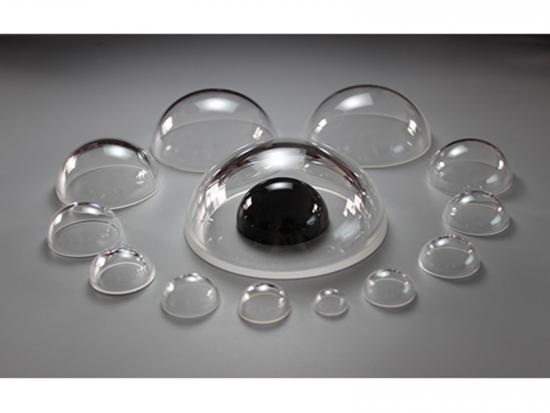
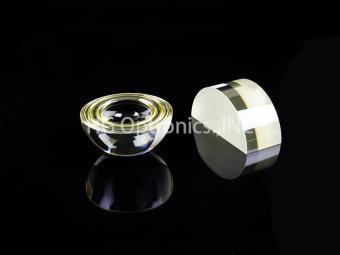
Optical domes are lenses with two concentric spherical surfaces. Sometimes they are being referred to as bent plan parallel plates. Consequently it is customary to define parallelism between two surfaces as the maximum thickness variation between the two surfaces.
Product Origin:
ChinaShipping Port:
Fuzhou, ChinaLead Time:
5-6weeks


In perfect domes the convex radius is equal to the sum of the dome thickness and concave radius. Slight departures from that rule are sometimes desired. Optical domes are used in IR missiles, for underwater photography as part of protective case and as a part of sun tracking solar collectors.
Optical Dome Manufacturing Capabilities
|
Material: |
Optical glass, Fused Silica, Silicon, Sapphire, crystals |
|
Diameter: |
Ф10mm -Ф200 mm |
|
DiameterTolerance: |
± 0.015mm |
|
Center thickness tolerance |
± 0.02mm |
|
Aperture: |
WithinФ100mm N=2;△N=0.3 |
|
Centration |
< 60" |
|
Surface Flatness: |
λ/4@632.8nm |
|
Surface Quality: |
40-20 |
|
Bevel: |
<0.1mm |
|
surface roughness |
0.5nm~ 1nm |
|
Coating: |
According to customer’s request |
 Leave A Message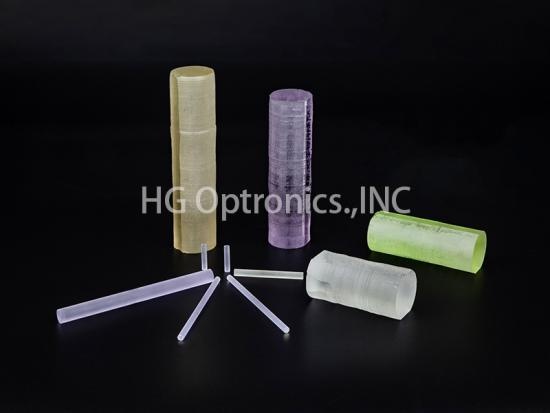
HGO grows Pr:YLF laser crystals using Czochralski technology. Pr3+:YLF has been found as promising laser material for producing visible lasers directly and UV lasers through intracavity second-harmonic generation. Very few laser materials have the necessary properties for the realization of lasing in the visible spectral range. Trivalent praseodymium (Pr3+) is known to be an interesting laser ion for use with solid-state lasers in the visible spectral range because of its energy levels scheme, providing several transitions in the red (640 nm, 3P0 to 3F2), orange (607 nm, 3P0 to 3H6), green (523 nm, 3P0 to 3H5), and dark red (720 nm, 3P0 3F3+3F4) spectral regions.
Read More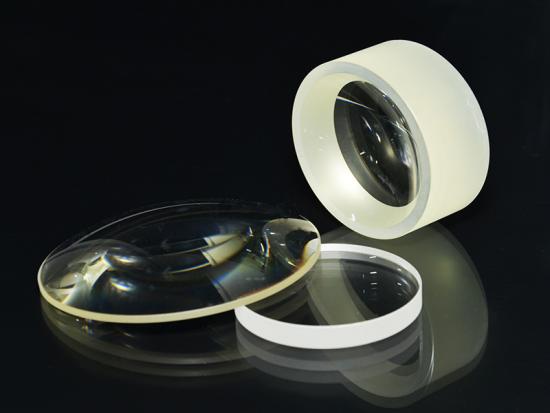
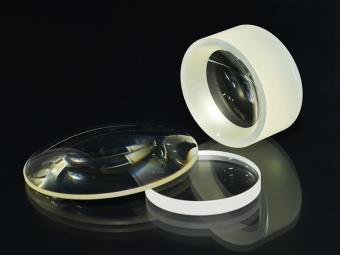
A Plano-Convex lens causes light to focus to a point,it has a positive focal length,which is ideal for light collimation or for focusing applications utilizing monochromatic illumination, in a range of industries. HG OPTRONICS offers Plano-Convexlenses with a variety of coating options.
Read More
Double Convex Lenses are used in image relay applications, or for imaging objects at close conjugates. Double Convex Lenses have positive focal lengths, along with two convex surfaces with equal radii. Aberrations will increase as the conjugate ratios increase. Double-Convex Lenses are used in a range of industries or applications. HG OPTRONICS offers Double Convex lenses with a variety of coating options.
Read More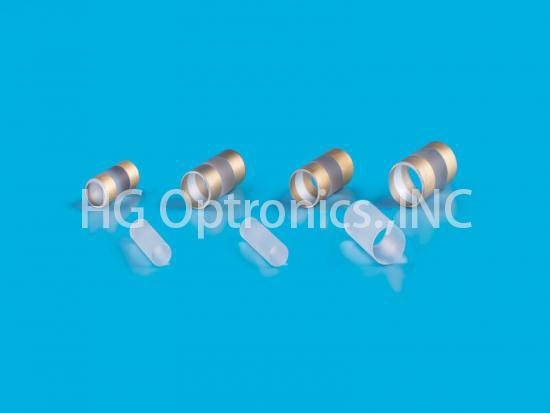
KDP Potassium Dihydrogen Phosphate and KD*P or DKDP Potassium Dideuterium Phosphate are among the most widely-used commercial NLO materials, characterized by good UV transmission, high damage threshold, and high birefringence, though their NLO coefficients are relatively low. They are usually used for doubling, tripling and quadrupling of a Nd:YAG laser under the room temperature. In addition, they are also excellent electro-optic crystals with high electro-optic coefficients, widely used as electro-optical modulators, such as Q-switches, Pockels Cells, etc.
Read More
Plano Concave Lenses are ideal for beam expansion, light projection, or for expanding an optical system's focal length. Plano Concave Lenses, which have one concave surface, are Optical Lenses with negative focal lengths. Plano-Concave Lenses should be shaped with the plano, or flat, surface towards the desired focal plane.Plano-Concave Lenses are ideal for use in a range of applications or industries. HG OPTRONICS offers Plano-Concave lenses with a variety of coating options.
Read More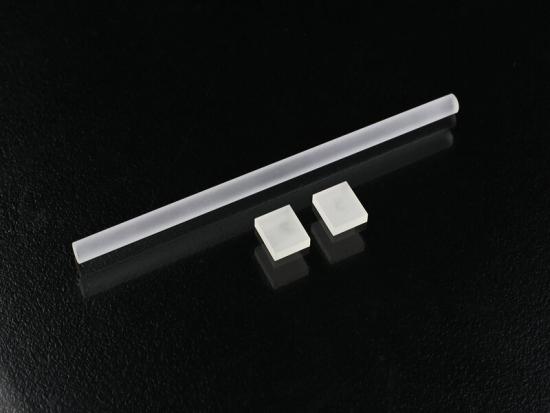
HGO grows LiF crystals in house using Czochralski technology. LiF crystal or lithium fluoride crystal is an optical material with outstanding transmittance in VUV region. It is also used for windows, prisms, and lenses in the visible and infrared in 0.104µm-7µm. LiF single crystal is sensitive to thermal shock and would be attacked by atmospheric moisture at 400°C. When working at a high temperature of 600°C, the LiF crystal softens and is slightly plastic, so it can be bent into radius plates. In addition irradiation produces color centers. Hence, users should take measures to protect LiF crystals from moisture and high energy radiation damages. What is more LiF can be cleaved along (100) plane and less commonly (110) plane. The optical characteristics are good and yet the structure is not perfect and cleavage is difficult.
Read More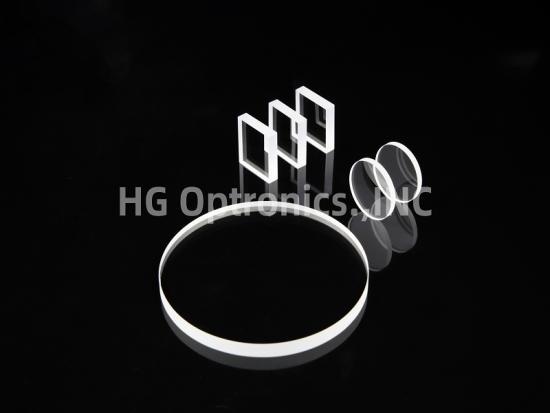
Calcium Fluoride windows and lenses for UV and IR spectrum. Custom made CaF2 windows, CaF2 lenses and wedges according to customer's specifications. CaF2 windows up to 220mm diameter; CaF2 wedges, prisms and CaF2 mirrors; Excimer CaF2 optics, Raman grade CaF2 optics and etc.
Read More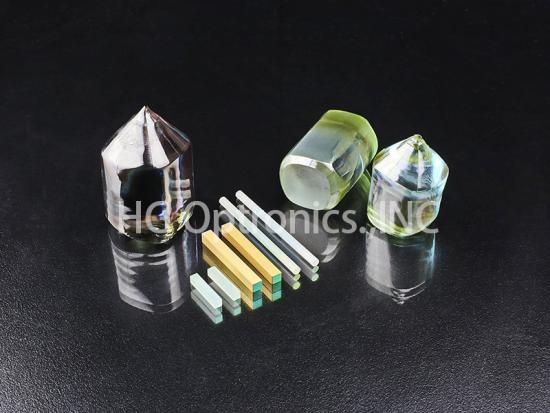
Nd:YVO4 (Neodymium Doped Yttrium Orthovanadate) crystals is one of the most promising commercially available diode pumped solid state laser materials, especially, for low to middle power density. This is mainly for its higher absorption and emission features than Nd:YAG crystal. Pumped by laser diodes, Nd:YVO4 crystal has been incorporated with high NLO coefficient crystals ( LBO, BBO, or KTP) to frequency-shift the output from the near infrared to green, blue, or even UV. This incorporation to construct all solid state lasers is an ideal laser tool that can cover the most widespread applications of lasers, including machining, material processing, spectroscopy, wafer inspection, light displays, medical diagnostics, laser printing, and data storage, etc. It has been shown that Nd:YVO4 based diode pumped solid state lasers are rapidly occupying the markets traditionally dominated by water-cooled ion lasers and lamp-pumped lasers, especially when compact design and single-longitudinal-mode outputs are required.
Read More
 IPv6 network supported