what are you looking for?
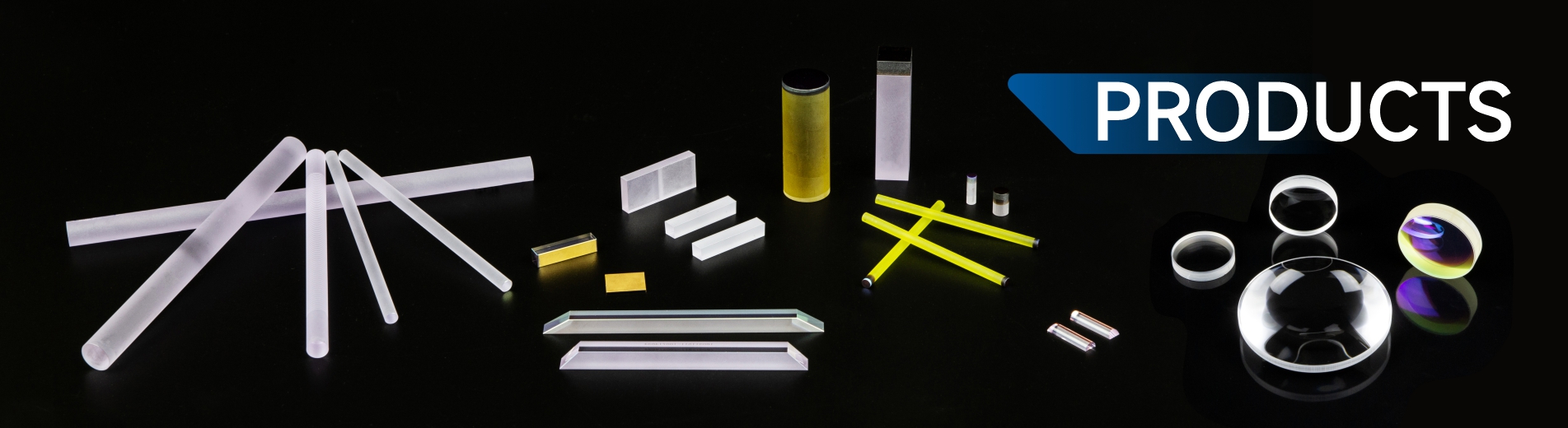
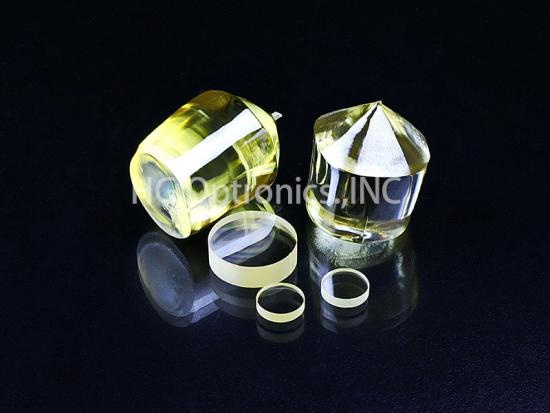
The Yttrium Orthovanadate (YVO4) is a positive uniaxial crystal grown with Czochralski method. It has good temperature stability and physical and mechanical properties. It is ideal for optical polarizing components because of its wide transparency range and large birefringence. It is an excellent synthetic substitute for Calcite (CaCO3) and Rutile (TiO2) crystals in many applications including fiber optic isolators and circulators, interleavers, beam displacers and other polarizing optics.
Product Origin:
ChinaShipping Port:
Fuzhou, ChinaLead Time:
3-4weeks


Descriptions:
Yttrium Orthovanadate (YVO4) is ideal for optical polarizing components and in many applications including fiber optic isolators and circulators, interleavers, beam displacers and other polarizing optics.
Main applications:
1) Fiber-optic isolators
2) Beam displacers.
3) optical circulators
Comparison of basic properties betweenYVO4 and Other Birefringent Crystals.
|
|
YVO4 |
TiO2 |
CaCO3 |
LiNbO3 |
|
|
Thermal Expansion (/℃) |
c-axis |
11.4x10⁻⁶ |
9.2x10⁻⁶ |
26.3x10⁻⁶ |
16.7x10⁻⁶ |
|
a-axis |
4.4x10⁻⁶ |
7.1x10⁻⁶ |
5.4x10⁻⁶ |
7x10⁻⁶ |
|
|
Refractive Index |
no |
1.9447@1550nm |
2.454@1530nm |
1.6346@1497nm |
2.2151@1440nm |
|
ne |
2.1486@1550nm |
2.710@1530nm |
1.4774@1497nm |
2.1413@1440nm |
|
|
Birefringence(ne-no) |
0.2039@1550nm |
0.256@1530nm |
-0.1572@1497nm |
-0.0738@1440nm |
|
|
Mohs Hardness |
5 |
6.5 |
3 |
5 |
|
|
Deliquescence |
None |
None |
Weak |
None |
|
|
Transparency range |
0.4-5μm |
0.4-5μm |
0.35-2.3μm |
0.4-5μm |
|
Basice properties of YVO4 crystal:
|
Transparency Range |
High transmittance from 0.4 to 5μm |
|
|
Crystal Symmetry |
Zircon Tetragonal, space group D4h |
|
|
Crystal Cell |
a=b=7.12Å,c=6.29Å |
|
|
Density |
4.22g/cm3 |
|
|
Mohs Hardness |
5 |
|
|
Hygroscopic Susceptibility |
Non-hygroscopic |
|
|
Thermal Expansion Coefficient |
αa = 4.43×10⁻⁶/K;αc = 11.37 ×10⁻⁶/K |
|
|
Thermal Conductivity Coefficient |
//C: 5.23 W/m/K; ⊥C: 5.10 W/m/K |
|
|
Thermal Optical Coefficient |
dna/dT = 8.5×10⁻⁶/K;dnc/dT = 3.0×10⁻⁶/K |
|
|
Crystal Class |
Positive uniaxial with no=na=nb, ne=nc |
|
|
Refractive Indices, Birefringence |
no = 1.9929, ne = 2.2154, Δn = 0.2225, ρ= 6.04° at 630nm |
|
|
Sellmeier Equation(λ in μm) |
no2 = 3.77834 + 0.069736/(λ2 - 0.04724) - 0.0108133λ2 |
|
HGO offers NdYVO4 specifications:
|
±0.1mm |
|
|
Flatness |
|
|
Wavefront distortion |
λ/4@ 632.8nm |
|
Surface Quality |
10/5 per MIL-O-13830B |
|
Parallelism |
10″ |
|
Perpendicularity |
10′ |
|
Bevel/Chamfer |
<0.1mm@45deg. |
|
Chips |
<0.1mm |
|
Clear Aperture |
>95% |
|
Coating |
AR/HR (IAD, EB, IBS) coating upon customer’s request |
|
Damage Threshold |
750MW/CM2 at 1064nm, TEM00, 10ns, 10Hz |
|
Quality Warranty Period |
One year under proper use |
Why Choose HGO ?
HG OPTRONICS.,INC. has the ability to grow high purity YVO4 ( Un-doped Yttrium Orthovanadate) crystals. High quality of starting material is used for crystal growth and strict quality control is applied to our YVO4 absorption ,scattering loss, bulk loss , inclusions and all the other required processing specs which assures that each crystal from HGO will comply with customer’s specification and perform well in laser system. HGO has now completed a mass-production line and have strong ability to supply such crystals with large quantity in short time.
What is more, based on our advanced diffusion bonding technology, diffusion bonding composites of NdYVO4 and YVO4 are extremely useful and very popular for higher power Nd doped vanade based laser systems. High quality of diffusion bonding crystals NdYVO4 with YVO4 endcap are available from stock and also customization.
 Leave A Message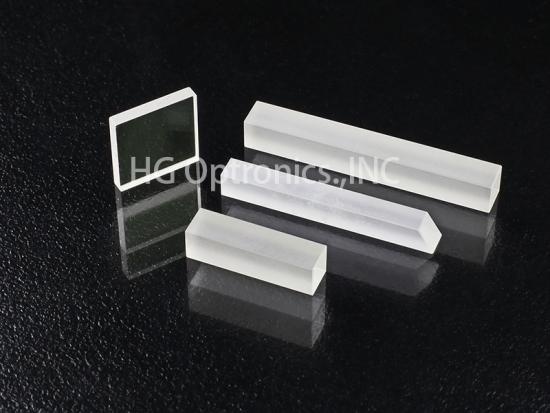
α-BBO (α-BaB2O4) is a negative uniaxial crystal which has large birefringence over a broad transparent range of 190nm to 3500nm. α-BBO is an excellent crystal especially in UV and high power applications. The physical, chemical, thermal, and optical properties of alpha-BBO crystal are similar to those of Beta-BBO. However, there is no second order nonlinear effect in alpha-BBO crystal due to the centrosymmetry in its crystal structure and thus it has no use for second order nonlinear optical processes. Instead, alpha-BBO is widely used for fabrication of polarizers, polarizing beam displacers, phase retarders, birefringent plates, and time delay compensators especially those for UV and high power lasers.
Read More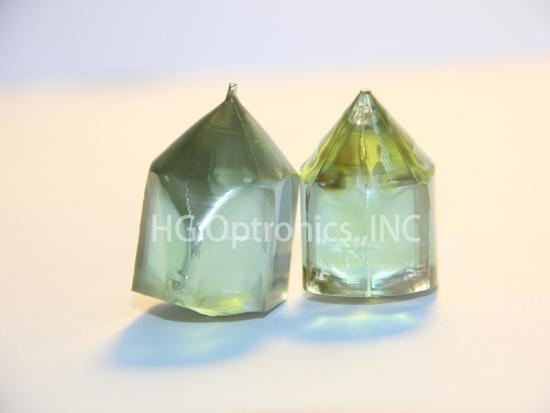
Nd:GdVO4, is a promising material for diode pumped lasers. Similar to the more well-known Nd:YVO4 crystal, Nd:GdVO4 crystal also exhibits high gain, low threshold, and high absorption coefficients at pumping wavelengths. Nd:GdVO4 has the additional advantage over Nd:YVO4 of a much higher thermal conductivity. For CW lasing at 1.06 um and 1.34 um and intracavity doubling with KTP and LBO, the gadolinium vanadate have produced a higher slope efficiency or optical conversion than Nd:YVO4.
Read More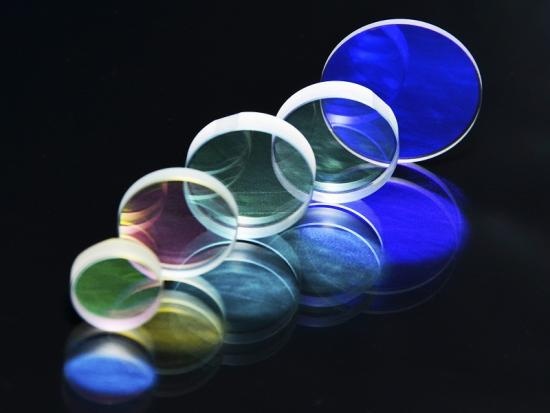
Our beamsplitter plates can be used in high power laser system. When using beamsplitter plates, it is important to make it in mind that the two partial beams travel in different optical paths. The optical paths depend on the incident angle and the thickness of plates.
Read More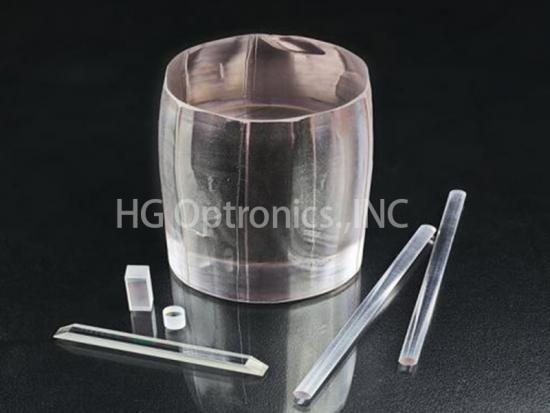
Nd:YAG is the earliest and most famous laser host crystal. Since it combines great advantages in many basic properties,Nd:YAG is the ubiquitous presence for near-infrared solid-state lasers and their frequency-doubler, tripler, and higher order multiplier. It is widely used in industrial, medical, military and scientific fields.. Nd:YAG crystals are wildly used in all types of solid-state laser systems-frequency-doubled continuous wave, high-energy Q-switched, and so forth.Its good fluorescent lifetime thermal conductivity and physical strengths makes it suitable for high power lamp pumped laser.
Read More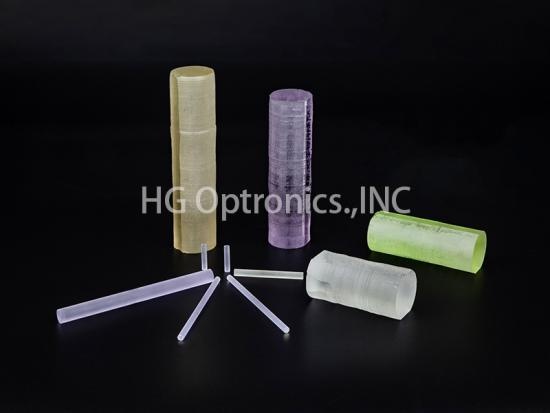
HGO grows Ho:YLF laser crystals using Czochralski technology. Ho:YLF is a very attractive laser material, because the lifetime of the upper laser level is much longer ( ~ 14 ms) than in Ho:YAG and the emission cross sections are higher. Additionally the thermal lens in Ho:YLF is much weaker, which helps to generate diffraction limited beams even under intense end-pumping. The primary advantage of directly pumping the Ho 5I7 is that it does not have to depend on energy transfer, which lends itself to various radiative and non-radiative losses. Up-conversion losses that have deleterious effect in high-energy Q-switched lasers are eliminated.
Read More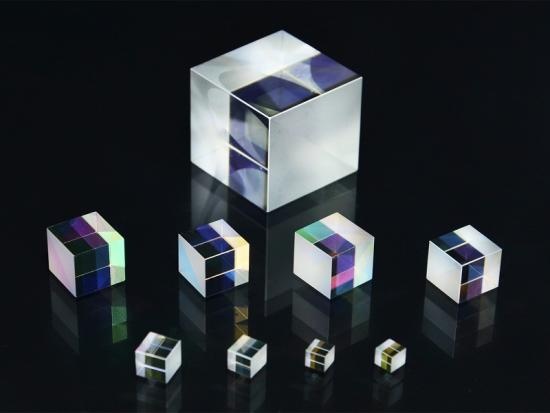
Polarization Beamsplitter Cubes are constructed by cemented two right angle prisms, the hypotenuse of one prism is coated with polarization dielectric coating. When used with normal incident, un-polarized light, the incident beam is separated into two polarized beams, p-polarized component is passed straight through, s-polarized component is reflected out at 90deg.
Read More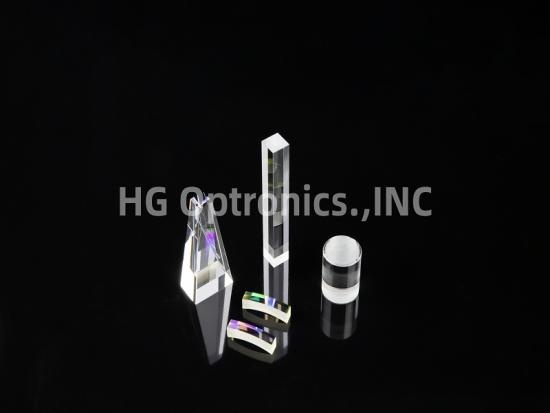
Rod Lenses are used for fiber coupling and laser diode beam shaping, lenses with a 0mm working distance are ideal for collimation of single and multi-mode optical fibers and laser diodes because the lens can be positioned and glued directly to the emission source. For focusing applications, or in instances where the lens can’t be in direct contact with the emission source, all lenses are available with a small working distance as well. HG OPTRONICS can provide the size from Φ1~Φ15mm, quantity price and custom sizes, including variations in polished/ground surfaces, are available to customers upon request.
Read More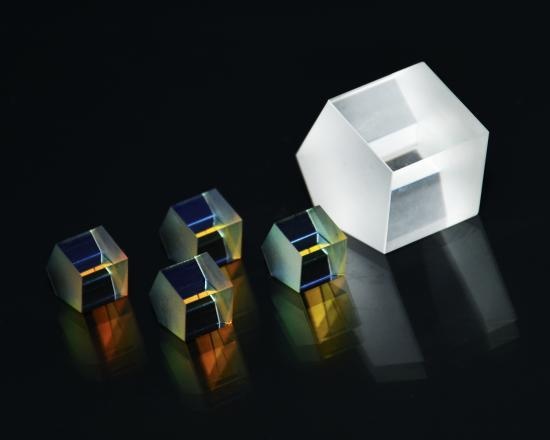
Penta Prisms are used to define right angles in optical systems. Penta Prisms, which provide right handed images,feature a ray deviation of 90°. Penta Prisms are five-sided prisms are unaffected by slight movements. HG OPTRONICS offers a variety of Penta Prisms for optimal performance in the Ultraviolet (UV), Visible, or Infrared (IR) spectrums.
Read More
 IPv6 network supported