what are you looking for?
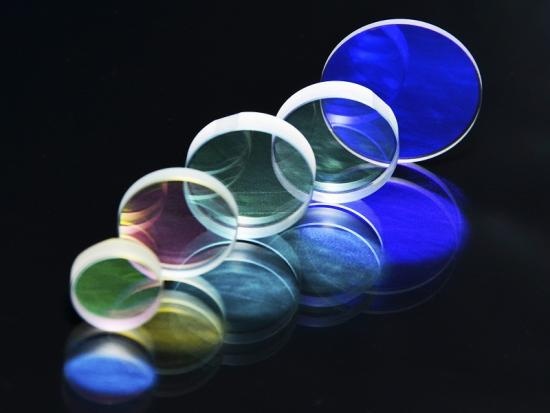
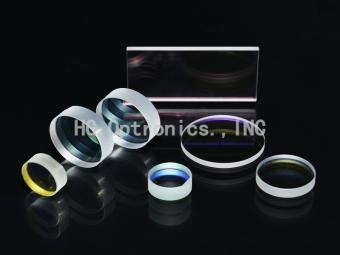
Laser Line Mirrors are used for beam-steering in demanding laser applications. Laser Line Mirrors are Optical Mirrors that have been designed for specific laser types or wavelengths.
Product Origin:
ChinaOrder(MOQ):
10Shipping Port:
Fuzhou, ChinaLead Time:
4 weeks


3. High Power Grade Laser Mirror
Laser Line Mirrors are used for beam-steering in demanding laser applications. Laser Line Mirrors are Optical Mirrors that have been designed for specific laser types or wavelengths.
3.1. What HG OPTRONICS can offer for you?
|
Substrate Materials: |
N-BK7, Fused silica, Pyrex |
|
Dimensional tolerance: |
+/-0.1mm |
|
Surface quality: |
20-10 |
|
Parallelism: |
1’ |
|
Flatness: |
λ/8 per 25mm@633nm |
|
Bevel: |
Protective |
|
One surface: |
Laser grade Polished and HR coating |
|
The other surface: |
Fine ground |
|
Angle of incident: |
0°or 45° |
3.2. What are the key features of Laser Mirror?
HG OPTRONICS can produce the laser mirror with the following features:
1)Specified wavelength applications
2)High precision
3)High reflectivity
4)High damage threshold
3.3. Which wavelength can HG OPTRONICS provide?
HG OPTRONICS can offer the Laser Mirror with 355nm, 532nm, 1064nm, 1047nm, 1053n. Others can be available according to customers’ requirements.
 Leave A Message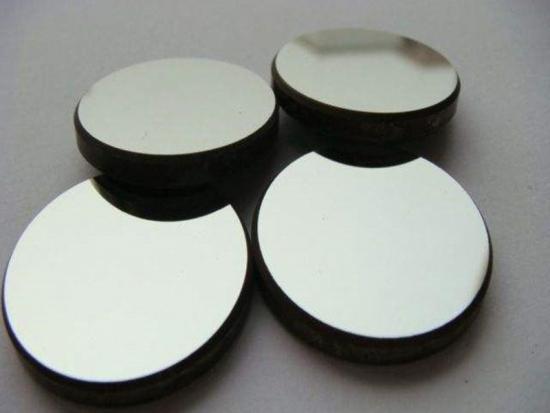
HG Optronics.,INC. can provide Metal Coated Mirror,Dielectric Coated Mirror and Dichroic Mirror which are made of substrate such as BK7, Optical glass, Fused Silica, CaF2 and so on.
Read More
The dichroic mirror is a mirror with significantly different reflection or transmission properties at two different wavelengths, it’s characterized by almost complete transmission of light at certain wavelengths and almost complete reflection of light at other wavelengths. It can be widely used in Laser technology applications.
Read More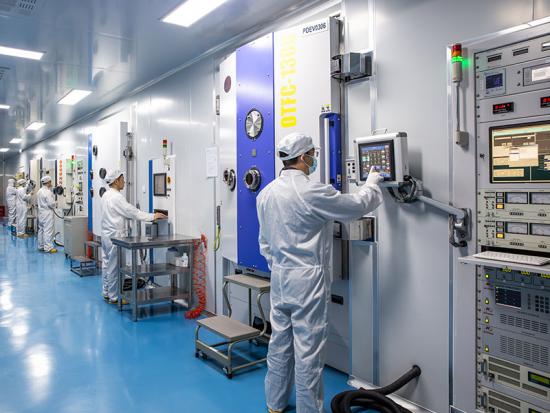
HGO have advanced coating machines which can meet endusers’different application requirement. We can very high laser induced damaged threshold coating with IAD, EB and IBS coating techniques , also Cr-Au, Aluminum and silver mental coating can also be available in HGO. Customers are very welcome to contact with us for further information.
Read More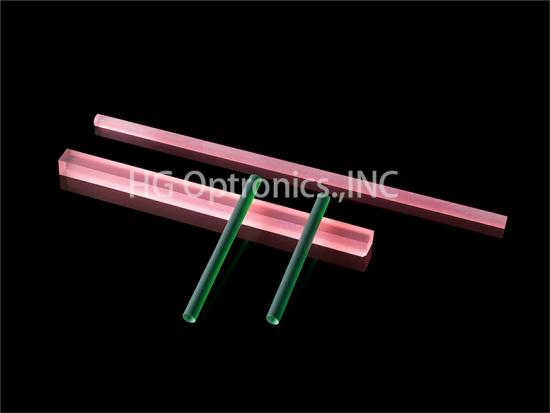
Er: YAG (Erbium-doped Yttrium Aluminum Garnet) is a solid-state crystal widely used as a laser medium in various medical and dental applications. It is made by doping erbium ions into yttrium aluminum garnet (YAG) crystals and can emit laser light with a wavelength of approximately 2.94 micrometers in the infrared spectrum.
Read More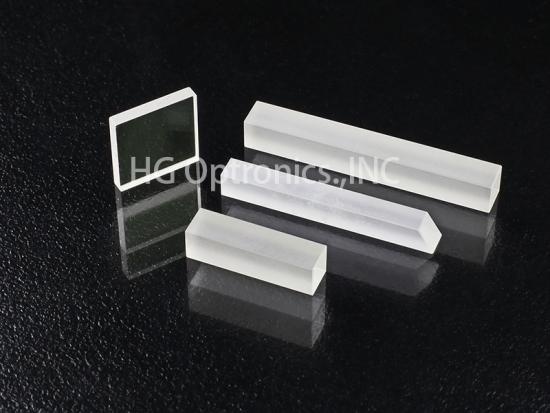
α-BBO (α-BaB2O4) is a negative uniaxial crystal which has large birefringence over a broad transparent range of 190nm to 3500nm. α-BBO is an excellent crystal especially in UV and high power applications. The physical, chemical, thermal, and optical properties of alpha-BBO crystal are similar to those of Beta-BBO. However, there is no second order nonlinear effect in alpha-BBO crystal due to the centrosymmetry in its crystal structure and thus it has no use for second order nonlinear optical processes. Instead, alpha-BBO is widely used for fabrication of polarizers, polarizing beam displacers, phase retarders, birefringent plates, and time delay compensators especially those for UV and high power lasers.
Read More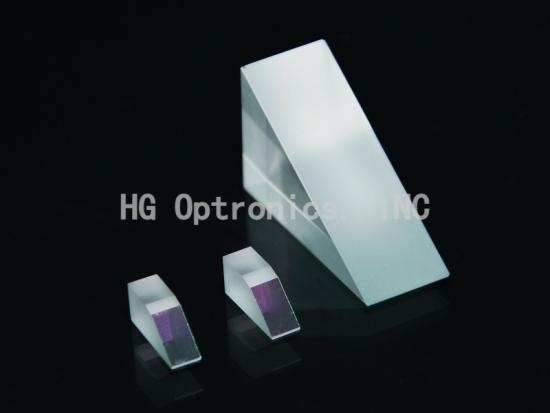
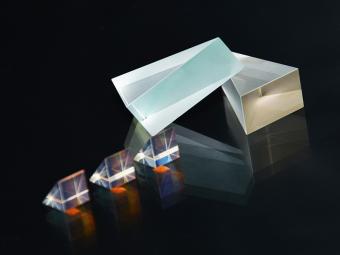
In optics, a prism is a transparent optical element with flat, polished surfaces that refract light. At least two of the flat surfaces must have an angle between them. The exact angles between the surfaces depend on the application. The traditional geometrical shape is that of a triangular prism with a triangular base and rectangular sides, and in colloquial use "prism" usually refers to this type. Some types of optical prism are not in fact in the shape of geometric prisms. Prisms can be made from any material that is transparent to the wavelengths for which they are designed.
Read More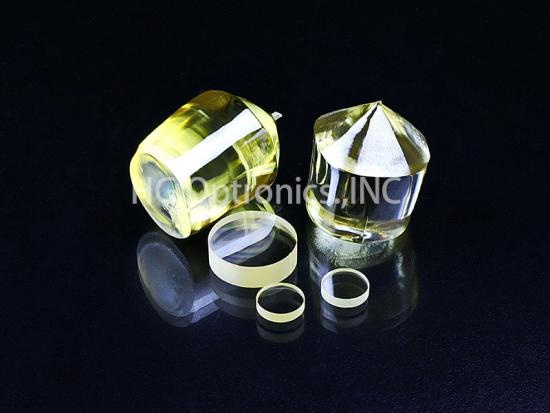
The Yttrium Orthovanadate (YVO4) is a positive uniaxial crystal grown with Czochralski method. It has good temperature stability and physical and mechanical properties. It is ideal for optical polarizing components because of its wide transparency range and large birefringence. It is an excellent synthetic substitute for Calcite (CaCO3) and Rutile (TiO2) crystals in many applications including fiber optic isolators and circulators, interleavers, beam displacers and other polarizing optics.
Read More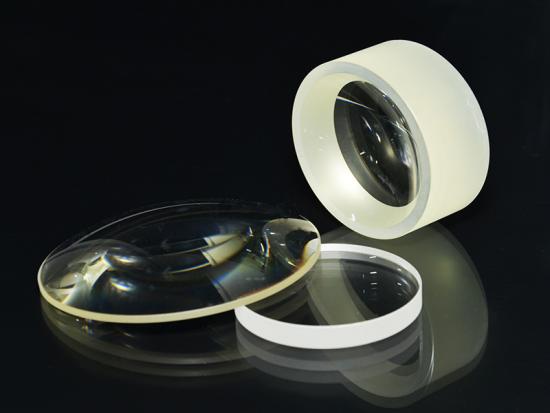
Achromatic Lenses are used to minimize or eliminate chromatic aberration. The achromatic design also helps minimize spherical aberrations. Achromatic Lenses are ideal for a range of applications, including fluorescence microscopy, image relay, inspection, or spectroscopy. Achromatic Lenses, which are often designed by either cementing two elements together or mounting the two elements in a housing, create smaller spot sizes than comparable singlet lenses.
Read More
 IPv6 network supported