what are you looking for?
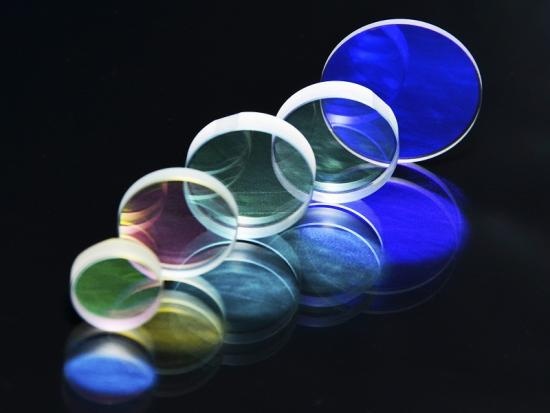
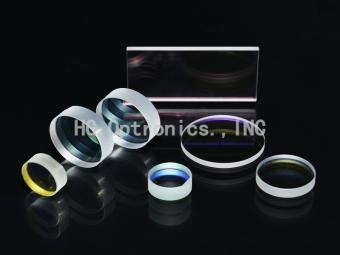
Laser Line Mirrors are used for beam-steering in demanding laser applications. Laser Line Mirrors are Optical Mirrors that have been designed for specific laser types or wavelengths.
Product Origin:
ChinaOrder(MOQ):
10Shipping Port:
Fuzhou, ChinaLead Time:
4 weeks


3. High Power Grade Laser Mirror
Laser Line Mirrors are used for beam-steering in demanding laser applications. Laser Line Mirrors are Optical Mirrors that have been designed for specific laser types or wavelengths.
3.1. What HG OPTRONICS can offer for you?
|
Substrate Materials: |
N-BK7, Fused silica, Pyrex |
|
Dimensional tolerance: |
+/-0.1mm |
|
Surface quality: |
20-10 |
|
Parallelism: |
1’ |
|
Flatness: |
λ/8 per 25mm@633nm |
|
Bevel: |
Protective |
|
One surface: |
Laser grade Polished and HR coating |
|
The other surface: |
Fine ground |
|
Angle of incident: |
0°or 45° |
3.2. What are the key features of Laser Mirror?
HG OPTRONICS can produce the laser mirror with the following features:
1)Specified wavelength applications
2)High precision
3)High reflectivity
4)High damage threshold
3.3. Which wavelength can HG OPTRONICS provide?
HG OPTRONICS can offer the Laser Mirror with 355nm, 532nm, 1064nm, 1047nm, 1053n. Others can be available according to customers’ requirements.
 Leave A Message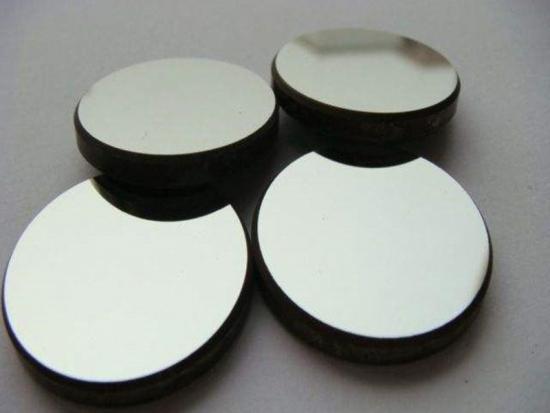
HG Optronics.,INC. can provide Metal Coated Mirror,Dielectric Coated Mirror and Dichroic Mirror which are made of substrate such as BK7, Optical glass, Fused Silica, CaF2 and so on.
Read More
The dichroic mirror is a mirror with significantly different reflection or transmission properties at two different wavelengths, it’s characterized by almost complete transmission of light at certain wavelengths and almost complete reflection of light at other wavelengths. It can be widely used in Laser technology applications.
Read More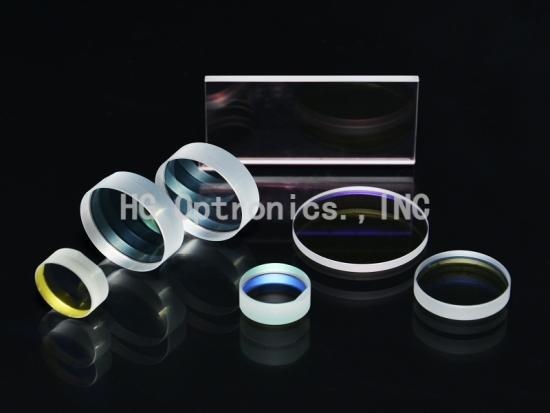
Silicon is used as an optical window primarily in the 3 to 5 micron band and as a subsrate for production of optical filters and windows. Silicon (Si) is grown by Czochralski pulling techniques (CZ) and contains some oxygen that causes an absorption band at 9 microns. To avoid this, material can be prepared by a Float-Zone (FZ) process. Optical silicon is generally lightly doped (5 to 40 ohm cm) for best transmission above 10 microns, and doping is usually boron (P-type) and phosphorus (N-type). After doping silicon has a further pass band: 30 to 100 microns which is effective only in very high resistivity uncompensated material.
Read More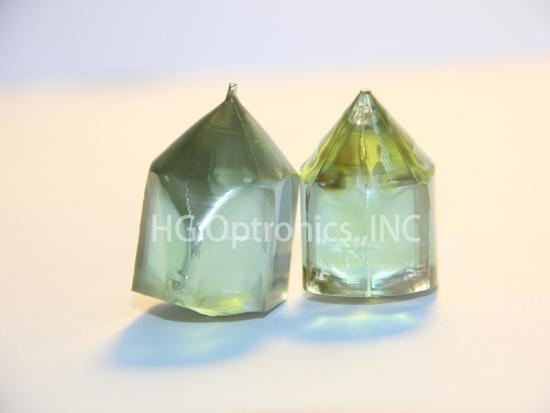
Nd:GdVO4, is a promising material for diode pumped lasers. Similar to the more well-known Nd:YVO4 crystal, Nd:GdVO4 crystal also exhibits high gain, low threshold, and high absorption coefficients at pumping wavelengths. Nd:GdVO4 has the additional advantage over Nd:YVO4 of a much higher thermal conductivity. For CW lasing at 1.06 um and 1.34 um and intracavity doubling with KTP and LBO, the gadolinium vanadate have produced a higher slope efficiency or optical conversion than Nd:YVO4.
Read More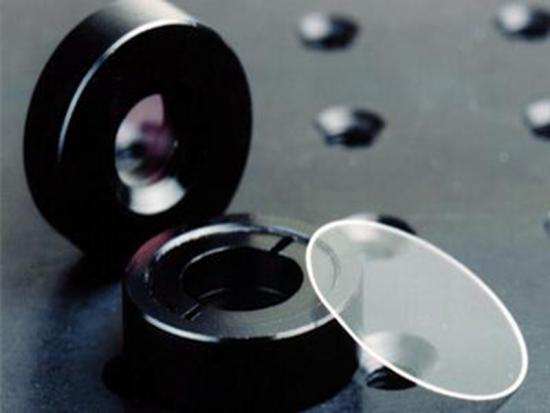
Waveplates (retardation plates or phase shifters) are made from materials which exhibit birefringence. The velocities of the extraordinary and ordinary rays through the birefringent material varies inversely with their refractive indices. This difference in velocities gives rise to a phase difference when the two beams recombine.
Read More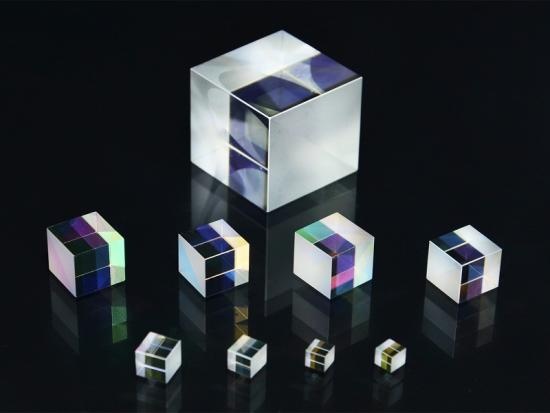
Polarization Beamsplitter Cubes are constructed by cemented two right angle prisms, the hypotenuse of one prism is coated with polarization dielectric coating. When used with normal incident, un-polarized light, the incident beam is separated into two polarized beams, p-polarized component is passed straight through, s-polarized component is reflected out at 90deg.
Read More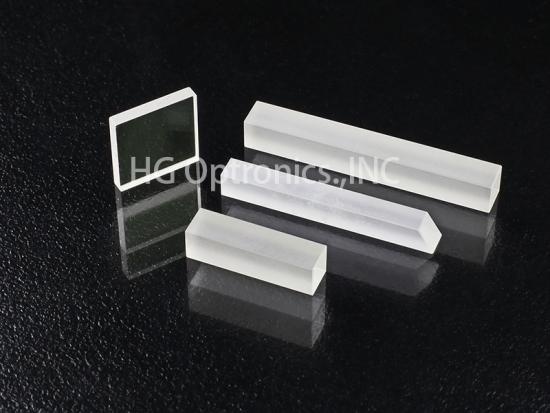
α-BBO (α-BaB2O4) is a negative uniaxial crystal which has large birefringence over a broad transparent range of 190nm to 3500nm. α-BBO is an excellent crystal especially in UV and high power applications. The physical, chemical, thermal, and optical properties of alpha-BBO crystal are similar to those of Beta-BBO. However, there is no second order nonlinear effect in alpha-BBO crystal due to the centrosymmetry in its crystal structure and thus it has no use for second order nonlinear optical processes. Instead, alpha-BBO is widely used for fabrication of polarizers, polarizing beam displacers, phase retarders, birefringent plates, and time delay compensators especially those for UV and high power lasers.
Read More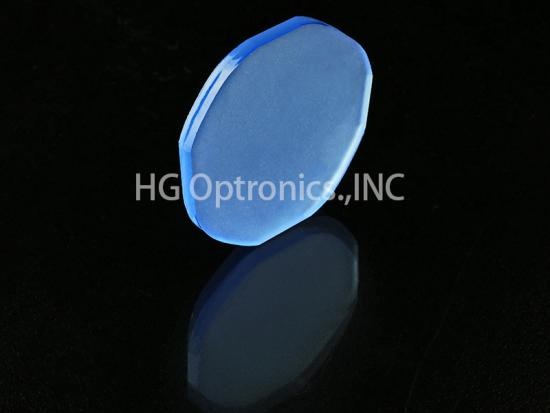
Co2+:MgAl2O4 Cospinel is a relatively new material for passive Q-switching in lasers emitting from 1.2 to 1.6 μm, in particular, for eye-safe 1.54 μm Er:glass laser, but also works at 1.44 μm and 1.34 μm wavelengths. Spinel is a hard, stable crystal that polishes well. Cobalt substitutes readily for magnesium in the Spinel host without the need for additional charge compensation ions. High absorption cross section (3.5×10⁻¹⁹ cm2) permits Q-switching of Er:glass laser without intracavity focusing both with flash-lamp and diode-laser pumping. Negligible excited-state absorption results in high contrast of Q-switch, i.e. the ratio of initial (small signal) to saturated absorption is higher than 10.
Read More
 IPv6 network supported